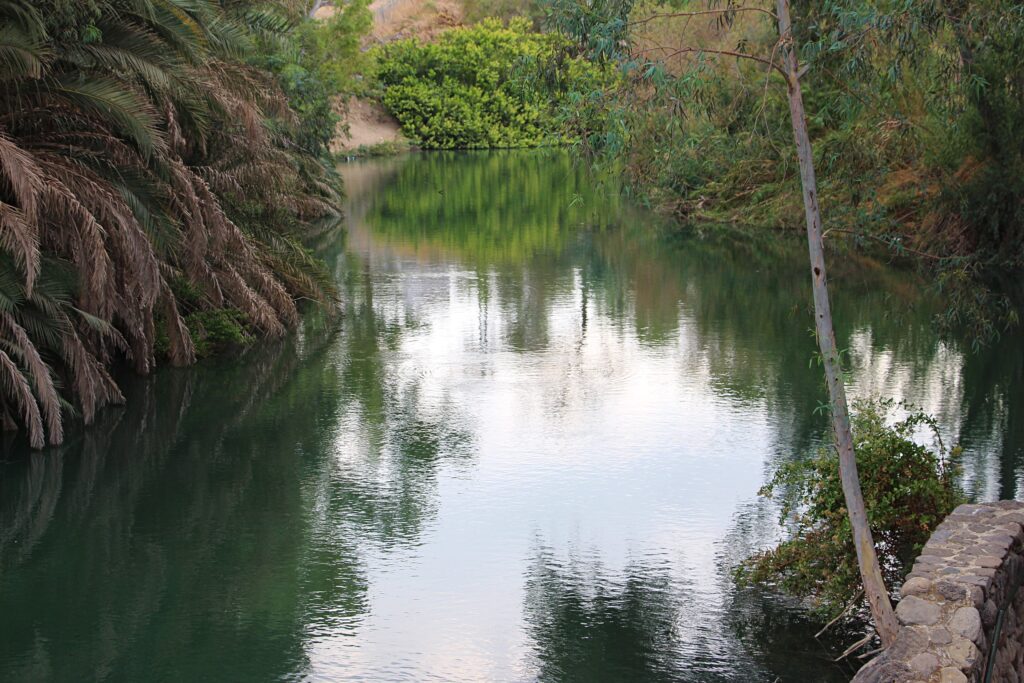
The Jordan is famous for being the site of events in the Old and New Testaments. I will review the major events below. Today it demarcates a large segment of the border between the countries of Israel and Jordan. (Incidentally, the modern political chant “from the river to the sea, Palestine will be free,” refers to the Jordan River and the Mediterranean Sea and calls for the eradication of the country of Israel by the killing of 7 million Israeli men, women, and children. The chant is a call for a true genocide. I hope most of the chanters do not understand what they are saying.)

The head of the Jordan River begins from a spring emerging from the side of a mountain in the far northern extent of the land of Israel, by the ancient ruins of Dan. Close to that site, other streams from Mount Hermon feed the river. From its source the river runs roughly 20-30 miles (32-48 km), measuring in a straight line, through the Hula Valley to the northern shore of the Sea of Galilee. Of course the river actually meanders and travels a larger distance. Running through the Sea of Galilee, it exits at the southwestern corner. From there it runs through the entirety of the Jordan Valley and empties into the Dead Sea. The Dead Sea has no outlet and all water and sediments are trapped, causing it to become ‘dead’. The Jordan Valley from the Sea of Galilee to the Dead Sea is about 66 miles (106 km) long in a straight line. Again, the actual river meanders and thus travels a much longer distance.
Below the Dead Sea is the desert Arabah Valley which runs all the way to the Red Sea. The river and the three valleys are in a roughly North-South axis. The three valleys and the entire Red Sea make up a part of a giant fault line called The Great Rift Valley. The fault line is active and major earthquakes have occurred along it over the millennia. For an example see my post on the City of Sussita (Hippos).
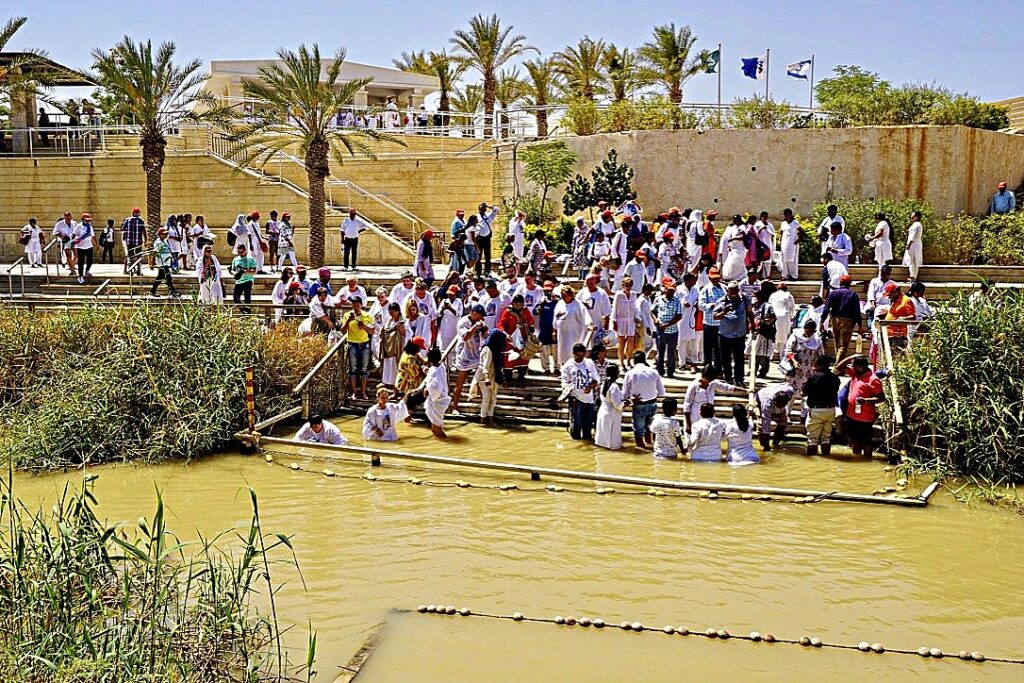
Both Israel and Jordan utilize the Jordan River for agriculture and drinking water. Water consumption of the Jordan River is as much as over 90%, leaving the current river less than 10% of the size it was in antiquity. With the understanding that what we see today is only about a tenth of the width as the river was in the Bible times, lets review some of the most important Biblical accounts at the Jordan River.
Old Testament
Joshua 3-4, the Israelites enter the promised land.
“And it came to pass, when the people removed from their tents, to pass over Jordan, and the priests bearing the ark of the covenant before the people; And as they that bare the ark were come unto Jordan, and the feet of the priests that bare the ark were dipped in the brim of the water, (for Jordan overfloweth all his banks all the time of harvest,) That the waters which came down from above stood and rose up upon an heap very far from the city Adam, that is beside Zaretan: and those that came down toward the sea of the plain, even the salt sea [Dead Sea], failed, and were cut off: and the people passed over right against Jericho. And the priests that bare the ark of the covenant of the Lord stood firm on dry ground in the midst of Jordan, and all the Israelites passed over on dry ground, until all the people were passed clean over Jordan.” Joshua 3:14-17.
Notice that the priests first needed to demonstrate faith by walking into the flood waters before the miracle was performed. That is a lesson for all of us.
2 Kings 2, Elijah crosses the Jordan before being taken up to heaven.
“And Elijah took his mantle, and wrapped it together, and smote the waters [of the Jordan], and they were divided hither and thither, so that they two went over on dry ground.” 2 Kings 2:8. “And it came to pass, as they still went on, and talked, that, behold, there appeared a chariot of fire, and horses of fire, and parted them both asunder; and Elijah went up by a whirlwind into heaven. And Elisha saw it,” 2 Kings 2:11-12.
Elisha then did the same thing when he crossed back across the Jordan. The Israelite crossing, plus Elijah and Elisha crossings are all reminders of the Israelite crossing of the Red Sea in Exodus 14.
2 Kings 5, Elisha tells Naaman the Syrian, a senior army officer, to wash 7 times in the Jordan to be healed of leprosy.
“So Naaman came with his horses and with his chariot, and stood at the door of the house of Elisha. And Elisha sent a messenger unto him, saying, Go and wash in Jordan seven times, and thy flesh shall come again to thee, and thou shalt be clean. But Naaman was wroth, and went away, and said, Behold, I thought, He will surely come out to me, and stand, and call on the name of the Lord his God, and strike his hand over the place, and recover the leper. Are not Abana and Pharpar, rivers of Damascus, better than all the waters of Israel? may I not wash in them, and be clean? So he turned and went away in a rage. And his servants came near, and spake unto him, and said, My father, if the prophet had bid thee do some great thing, wouldest thou not have done it? how much rather then, when he saith to thee, Wash, and be clean? Then went he down, and dipped himself seven times in Jordan, according to the saying of the man of God: and his flesh came again like unto the flesh of a little child, and he was clean.” 2 Kings 5:9-14.
The insult of not respecting Naaman’s rank by not coming to the door himself was part of the test of Naaman’s faith. In addition he was told to wash not once but seven times in the Israelite territorial River of Jordan.
New Testament
Matthew 3, Mark 1, and Luke 3, Jesus is baptized by John the Baptist.
“In those days came John the Baptist, preaching in the wilderness of Judæa,… Then cometh Jesus from Galilee to Jordan unto John, to be baptized of him. But John forbad him, saying, I have need to be baptized of thee, and comest thou to me? And Jesus answering said unto him, Suffer it to be so now: for thus it becometh us to fulfil all righteousness. Then he suffered him. And Jesus, when he was baptized, went up straightway out of the water: and, lo, the heavens were opened unto him, and he saw the Spirit of God descending like a dove, and lighting upon him: And lo a voice from heaven, saying, This is my beloved Son, in whom I am well pleased.” Matthew 3:1, 13-17.
As in all things, Jesus is our example.
< Previous post on The Book of Revelation from Patmos Island
Return to the Homepage
Next post on What Do Israelis Call their Native Born Children? >