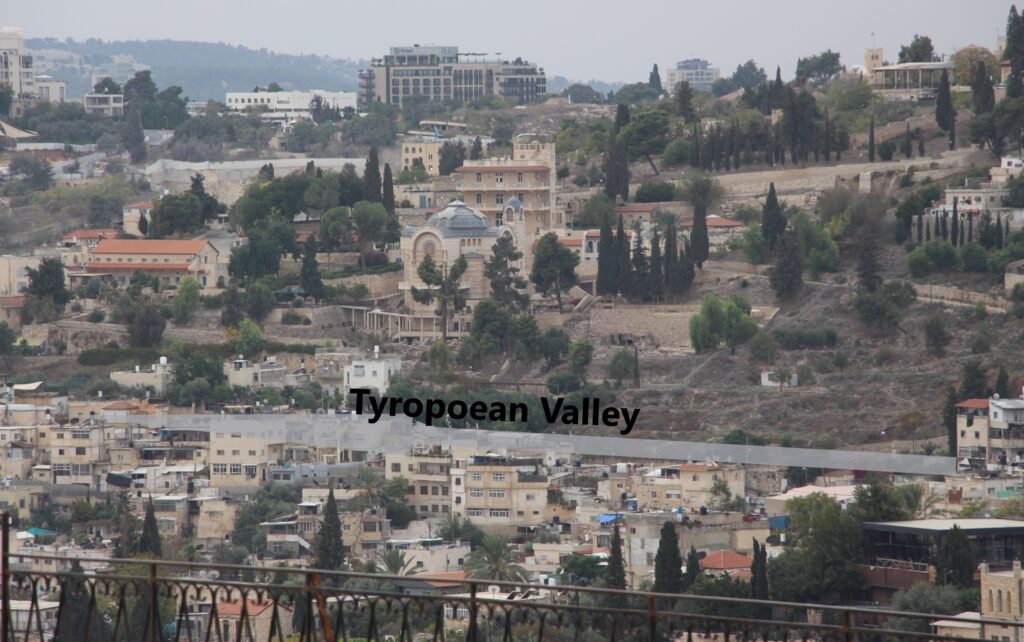
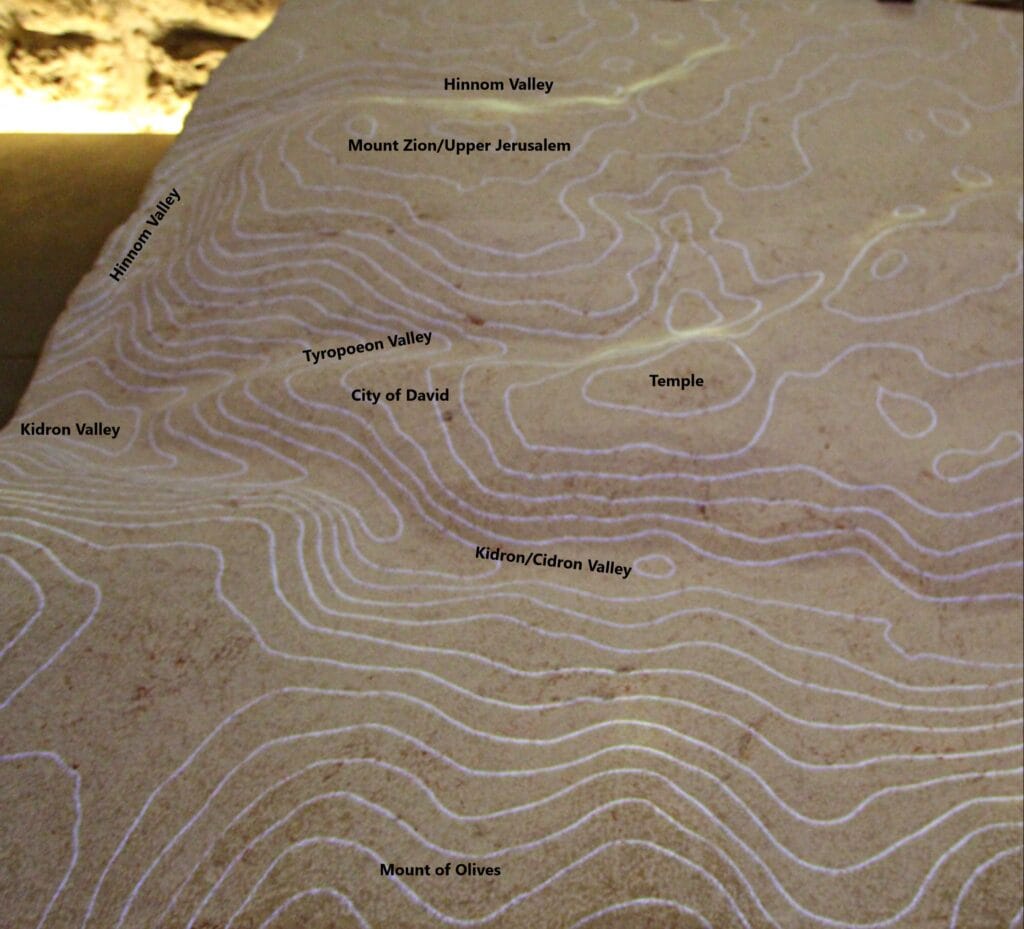
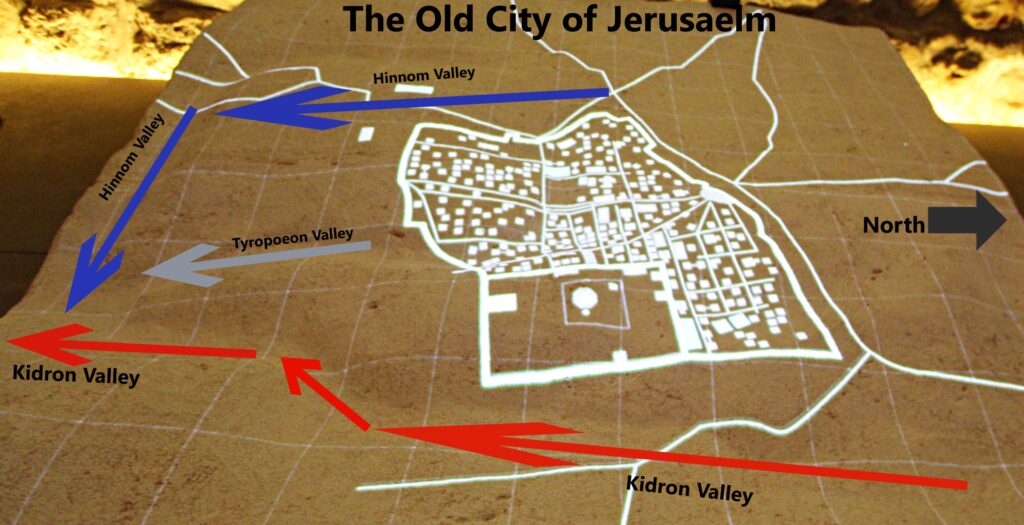
The Tyropoean Valley was the western border valley of Old Testament Jerusalem/The City of David, and was the central valley in New Testament Jerusalem. In New Testament times it separated the original City of David and the Temple Mount with the newer and wealthier section of Jerusalem on Mount Zion. The valley is not named in the Bible, but comes from the ancient historian Josephus (Wars 5:140). Tyropoean Valley means “Valley of the Cheese-makers.” However, the name may be a mistranslation coming from Hebrew to the Greek and possibly should be called the “Outer Valley.” Additionally, the Copper Dead Sea Scroll from Qumran (3Q15 col.8, line 4), called it the “Outer Valley.” Today it is more of a depression than a valley due to it being filled up with rubble from the two major destructions of Jerusalem: Babylonian destruction in 587 BC; and the Roman destruction in 70 AD. The valley empties into the confluence of the meeting of the two larger Jerusalem valleys, the Kidron and the Hinnom.
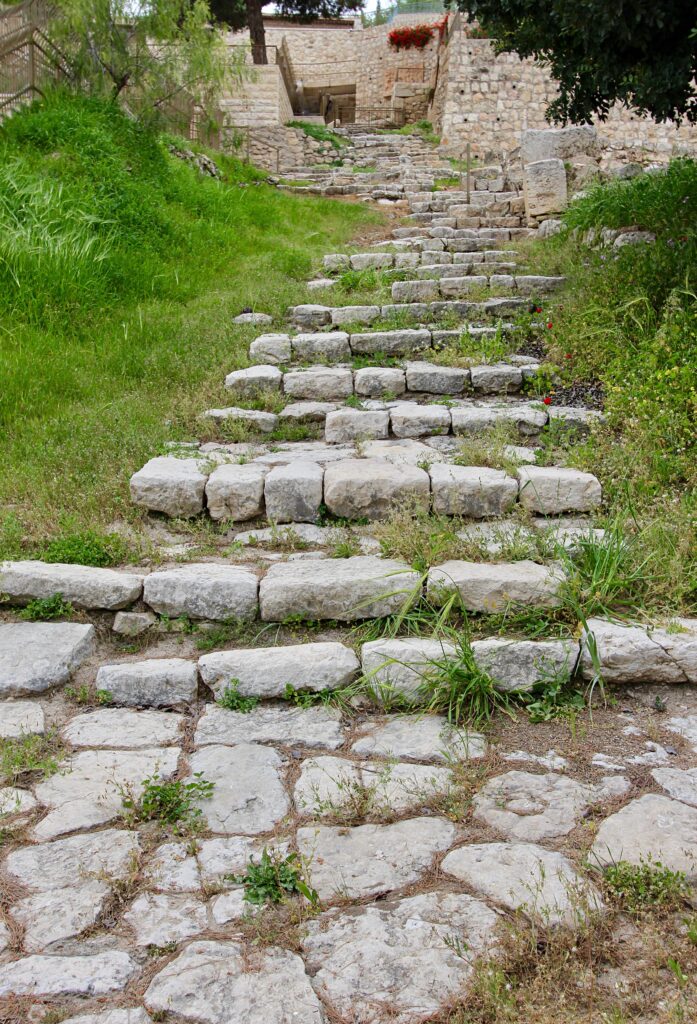
There is an ancient stair that runs from the Tyropoean Valley up to the Saint Peter in Gallicantu Church. That stair is probably the way Jesus was led by the soldiers to be tried before Caiaphas the High Priest.
“Then the band and the captain and officers of the Jews took Jesus, and bound him, and led him away to Annas first: for he was father in law to Caiaphas, which was the high priest that same year.” John 18:12-13.
Taking the route from Gethsemane through the Kidron Valley south to the lower city gates at the Tyropoean Valley and then up the stairs to Caiaphas’ house is the most secret route. The other route is directly through the city which likely would have led to being seen, and they feared rousing an angry crowd (Luke 22:2).
< Previous Post on The Valleys of Jerusalem: Part 2 The Hinnom Valley
Return to the Homepage
Next post on Mount Hermon: The Probable Mount of Transfiguration >
2 responses to “The Valleys of Jerusalem: Part 3 The Tyropoean Valley”
Dennis, thank you so much for the pictures & narrative. They always raise so many questions. You mentioned the Saint Peter church. Is that run by the Catholics & do they have modern mass, etc.? Also, since many of the ancient ruins have been uncovered, where do the current inhabinants live? Who maintains all the old sites like the stairs in your narrative. Keep up the goodm work.
Most of the churches are run by either the Roman Catholic or the Greek Orthodox churches. Yes, they hold regular services. Churches that are in ruins and were excavated (for example the one in Capernaum) are mostly owned by the Israel National Parks Authority and do not have services. The stairs leading up to St Peter in Gallicantu church are on church grounds but were excavated under Israeli archeological authority and so are basically jointly run, sort of. To keep the stairs from damage, the public can only look at them and not walk on them.
The local inhabitants live around the churches and sites and have done so for many years. Some even attend these churches. though most are either Jewish or Muslim and do not attend the services, but can be seen looking in as other tourists do. I once saw an Israeli family looking around the Church of the Holy Sepulchre just like foreign tourists.