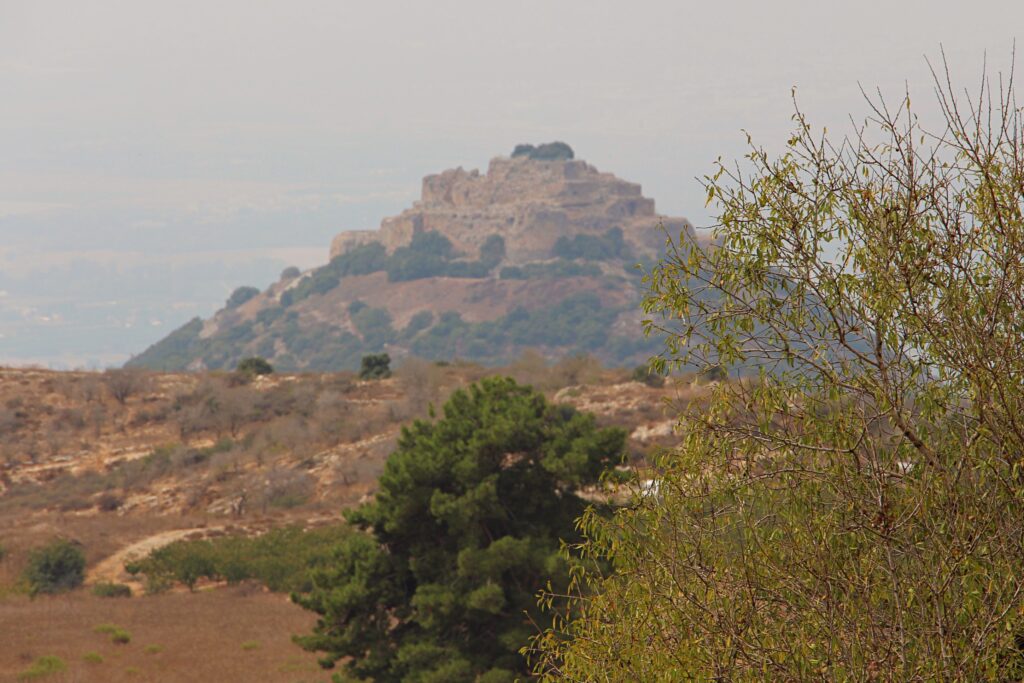
Today the mount is divided by three countries, Syria, Israel, and Lebanon. Mount Hermon is 9,232 feet/2,814 meters high in Syria (the Israeli part is 7,300 feet), in the extreme northeast of the Holy Land, being the southern point of a range of mountains called the Anti-Lebanon. It is by far the highest mountain in the greater Galilee area. It is visible not only from a great part of Galilee, but also from various places as far south as Jericho (but only on the rare clear day). On the Israeli side there is the Mount Hermon Ski resort which in winter is open for skiing when there is snow.
The Hermonites (Psalms 42:6) are the three peaks that make up Mount Hermon. Biblical poetry contains other allusions to this mountain (Psalms 89:12; 133:3; and Song of Solomon 4:8).
It is debated by scholars as to which mount is the Mount of Transfiguration, Mount Tabor or Mount Hermon. I believe it is more likely that our Lord’s Transfiguration took place on Mount Hermon and less likely it was the traditional location of Mount Tabor. A reason to support this is just before the Lord ascended the mount he visited Ceasarea Phillipi which is at the foot of Mount Hermon. (See Matthew 16:13, 17:1-9; Mark 8:27-30, 9:2-9; and Luke 9:18-21, 28-36). Tourists will be taken to Mount Tabor as it is much easier to access by tour groups visiting the Galilee than is the more distant Mount Hermon.
The Transfiguration Event. On the mount (which ever it is), Moses, and Elias (Elijah) appeared to Jesus, Peter, James, and John. They also heard the voice of God the Father bearing witness that Jesus is His beloved Son:
“And after six days Jesus taketh with him Peter, and James, and John, and leadeth them up into an high mountain apart by themselves: and he was transfigured before them. And his raiment became shining, exceeding white as snow; so as no fuller on earth can white them. And there appeared unto them Elias with Moses: and they were talking with Jesus. And Peter answered and said to Jesus, Master, it is good for us to be here … . And there was a cloud that overshadowed them: and a voice came out of the cloud, saying, This is my beloved Son: hear him. And suddenly, when they had looked round about, they saw no man any more, save Jesus only with themselves” Mark 9:2–10 (see also Matthew 17:1-9; Luke 9:28–36; and 2 Peter 1:16–18).
Hermon is also identified as Siron, Senir, and Siyon in Deuteronomy 3:9; 4:48.
On the southern foothills of Mount Hermon is the Nimrod Fortress (first picture above). It is the largest Arab castle in Israel, built in 1230 AD. It is the former stronghold of the Assassins (an order of Islamic extremists that existed between 1090 and 1275 AD). It was conquered by the Mongols 1260, and 1300 AD) and retaken by the Mamelukes (1291-1717 AD). The Turkish Ottoman Empire (1517-1917 AD) used the castle as a prison until it was abandoned. It was damaged during the French Mandate (1917-1946 AD) and again in the 1967 war. The Castle is largely preserved and gives an excellent view of the northern Jordan valley.
< Previous post on The Valleys of Jerusalem: Part 3 The Tyropoean Valley
Return to the Homepage
Next post on Paul was Taught and Baptized at Ananias House, Damascus >