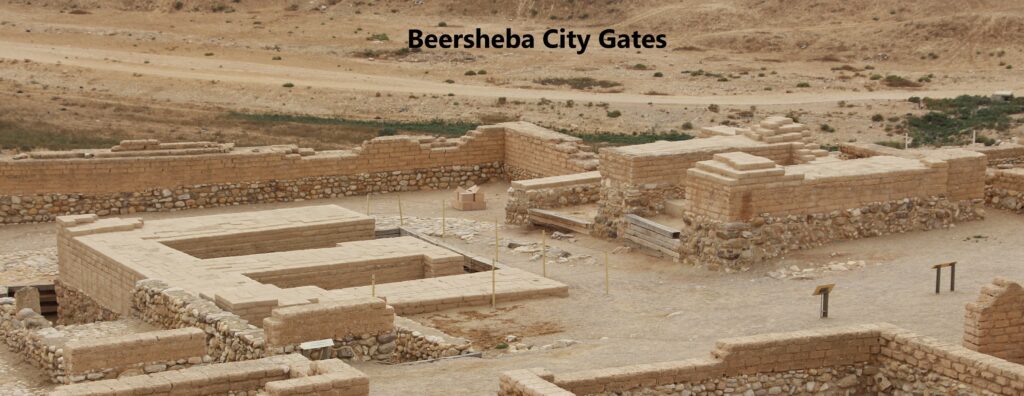
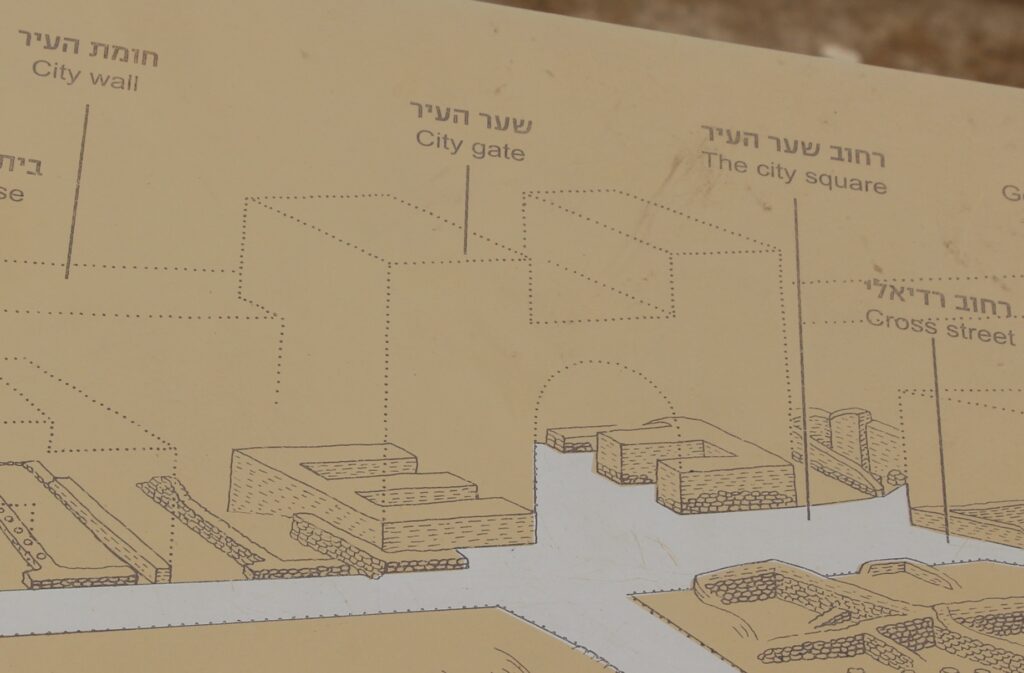
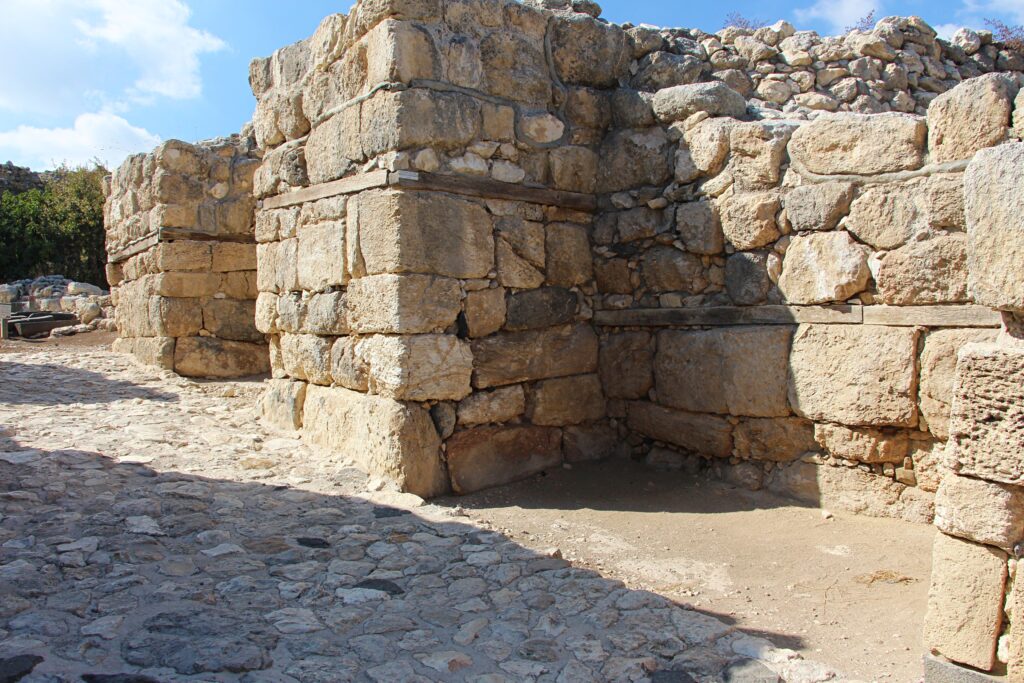
In Old Testament times (but not always in New Testament times), the Gates of a walled city were constructed with two rooms on each side of the entrance passageway. Benches lined the walls of the rooms. It was here that the “elders” or rulers of the city would sit. It was in the gates where judgement, punishment, and civic business was conducted. Here too people gathered to hear the latest news, royal proclamations, and prophets would speak (if they were in town). The gates were also incorporated into the walls for protection. They would be bolted shut each night and closed when the city was threatened.
Examples of Kings sitting in the city gates as well as on their thrones:
King David on occasion sat in the gate: “And David sat between the two gates: and the watchman went up to the roof over the gate unto the wall, and lifted up his eyes, and looked, and behold a man running alone. And, behold, Cushi came; and Cushi said, Tidings, my lord the king: for the Lord hath avenged thee this day of all them that rose up against thee. And the king said unto Cushi, Is the young man Absalom safe? And Cushi answered, The enemies of my lord the king, and all that rise against thee to do thee hurt, be as that young man is.” David learned that his rebellious son was killed in battle. 2 Samuel 18:24-32.
King Zedekiah sat in the city gate. He had just put the Prophet Jeremiah in the dungeon: “Now when Ebed-melech the Ethiopian, one of the eunuchs [officers is a better translation] which was in the king’s house, heard that they had put Jeremiah in the dungeon; the king then sitting in the gate of Benjamin; Ebed-melech went forth out of the king’s house, and spake to the king, saying,” Ebed-melech successfully pleaded for Jeremiah’s release. Jeremiah 38:7-13.
Elders/judges of the city sat in the gates to make legal transactions: “And Abraham stood up from before his dead, and spake unto the sons of Heth, saying, I am a stranger and a sojourner with you: give me a possession of a buryingplace with you, that I may bury my dead out of my sight… That he may give me the cave of Machpelah, which he hath, which is in the end of his field; for as much money as it is worth he shall give it me for a possession of a buryingplace amongst you. And Ephron dwelt among the children of Heth: and Ephron the Hittite answered Abraham in the audience of the children of Heth, even of all that went in at the gate of his city, saying,… And Abraham hearkened unto Ephron; and Abraham weighed to Ephron the silver, which he had named in the audience of the sons of Heth, four hundred shekels of silver, current money with the merchant.” Genesis 23:3-16.
Probably the best example of legal judgment is in the Book of Ruth: “Then went Boaz up to the gate, and sat him down there: and, behold, the kinsman of whom Boaz spake came by; unto whom he said, Ho, such a one! turn aside, sit down here. And he turned aside, and sat down. And he took ten men of the elders of the city, and said, Sit ye down here. And they sat down. And he said unto the kinsman, Naomi, that is come again out of the country of Moab, selleth a parcel of land, which was our brother Elimelech’s: And I thought to advertise thee, saying, Buy it before the inhabitants, and before the elders of my people. If thou wilt redeem it, redeem it: but if thou wilt not redeem it, then tell me, that I may know: for there is none to redeem it beside thee; and I am after thee. And he said, I will redeem it. Then said Boaz, What day thou buyest the field of the hand of Naomi, thou must buy it also of Ruth the Moabitess, the wife of the dead, to raise up the name of the dead upon his inheritance. And the kinsman said, I cannot redeem it for myself, lest I mar mine own inheritance: redeem thou my right to thyself; for I cannot redeem it. Now this was the manner in former time in Israel concerning redeeming and concerning changing, for to confirm all things; a man plucked off his shoe, and gave it to his neighbour: and this was a testimony in Israel. Therefore the kinsman said unto Boaz, Buy it for thee. So he drew off his shoe. And Boaz said unto the elders, and unto all the people, Ye are witnesses this day, that I have bought all that was Elimelech’s, and all that was Chilion’s and Mahlon’s, of the hand of Naomi. Moreover Ruth the Moabitess, the wife of Mahlon, have I purchased to be my wife, to raise up the name of the dead upon his inheritance, that the name of the dead be not cut off from among his brethren, and from the gate of his place: ye are witnesses this day. And all the people that were in the gate, and the elders, said, We are witnesses. The Lord make the woman that is come into thine house like Rachel and like Leah, which two did build the house of Israel: and do thou worthily in Ephratah, and be famous in Beth-lehem: And let thy house be like the house of Pharez, whom Tamar bare unto Judah, of the seed which the Lord shall give thee of this young woman. So Boaz took Ruth, and she was his wife: and when he went in unto her, the Lord gave her conception, and she bare a son.” Ruth 4:1-13. The law used by Boaz is in Deuteronomy 25:5-10.
Other examples of elders/judges in the city gates are at: Genesis 34:20-24; Deuteronomy 22:15-24; 1 Samuel 9:18; Job 29:7-13; Proverbs 22:22-23; Lamentations 1:4, 5:14; and Amos 5:12,15.
Gates can also represent who rules the city:
God’s blessing/covenant to Abraham included: “That in blessing I will bless thee, and in multiplying I will multiply thy seed as the stars of the heaven, and as the sand which is upon the sea shore; and thy seed shall possess the gate of his enemies;” Genesis 22:17.
Rebekah’s brothers gave a blessing to her in which they said: “And they blessed Rebekah, and said unto her, Thou art our sister, be thou the mother of thousands of millions, and let thy seed possess the gate of those which hate them.” Genesis 24:60.
After the first destruction of Jerusalem by the Babylonians: “The ways of Zion do mourn, because none come to the solemn feasts: all her gates are desolate: her priests sigh, her virgins are afflicted, and she is in bitterness.” Lamentations 1:4. See also Lamentations 5:14.
< Previous post on King David’s Tomb
Return to the Homepage
Leave a Reply